

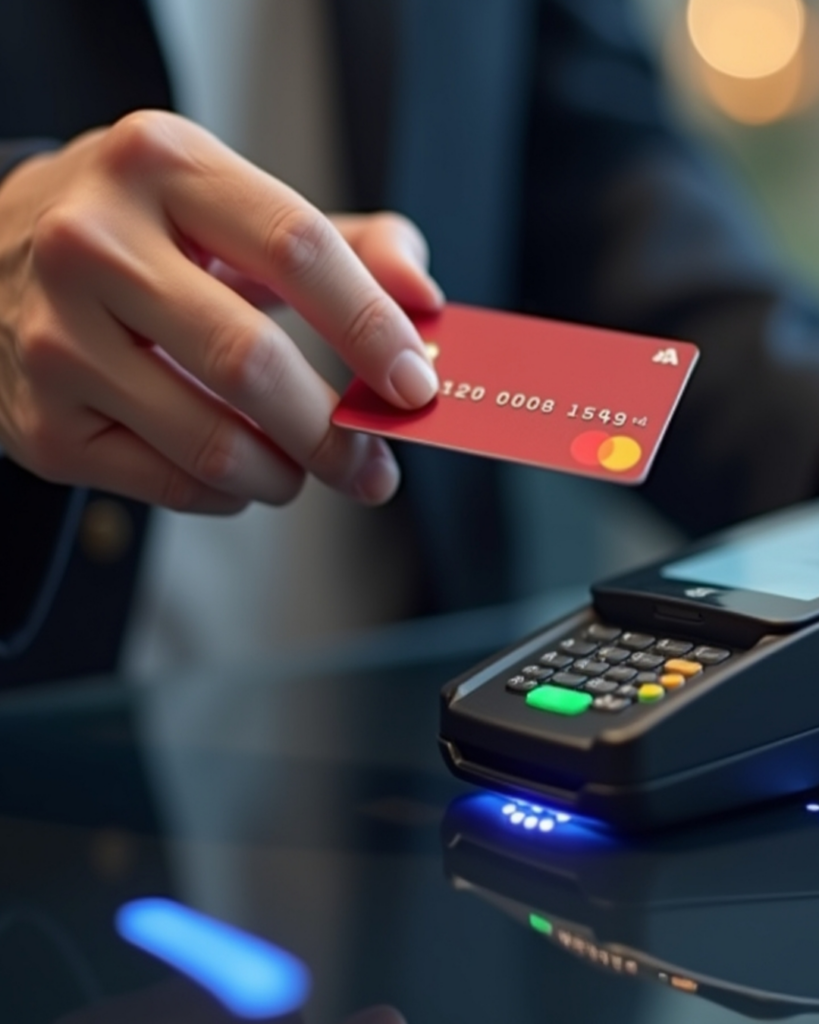
Interest-free credit card cashing Most people view their credit card limit as a consumption trap, a way to buy things they can’t afford today and pay for them dearly tomorrow. This is the consumer mindset.
The “Cash-Flow Optimizer” successful freelancers, small business owners, and savvy financial strategists view that same limit differently. They see it as Liquidity Arbitrage. Consider Sarah, a freelance graphic designer. Faced with a large software subscription due before a major client payment, she leveraged her credit limit not as debt, but as a short-term, interest-free bridge, ensuring her project stayed on track without dipping into her emergency fund.
Your credit limit represents a pool of dormant capital. When accessed correctly, it can function as an interest-free bridge loan for 20 to 55 days, allowing you to solve immediate cash flow gaps without triggering the predatory interest rates associated with traditional loans or bank cash advances.
This guide moves beyond the desperation typically associated with needing cash. Instead, we break down the mechanics of interest-free credit card cashing, transforming your plastic into a strategic financial tool.
What is Credit Card Cashing? (Defining the Strategy)
To leverage this strategy, we must first define it clearly for the modern financial landscape. It is crucial to distinguish this from a loan or a standard bank withdrawal.
Credit Card Cashing is a financial strategy used to convert a portion of a credit card’s available limit into liquid funds (cash) while bypassing standard cash advance fees and immediate interest accrual.
Unlike a bank loan, which requires approval and originates new debt, cashing utilizes the pre-approved credit you already possess. Interest-free credit card cashing The core of this strategy relies on the Grace Period.
Definition and Core Mechanics
When you make a standard purchase (e.g., buying a laptop), the bank does not charge you interest immediately. You are given a grace period typically between 21 and 55 days—to pay that balance off before interest kicks in. Always consult your specific credit card agreement for the exact terms and length of your grace period, Interest-free credit card cashing as these can vary significantly between issuers.
Strategic cashing structures the acquisition of cash to look like a purchase rather than a withdrawal. By doing so, you retain the grace period. This allows you to hold the cash for weeks with 0% effective interest, provided you settle the balance before the statement due date.
The Economic Trap: Why Standard Cash Advances Fail
If you need liquidity, your bank has likely already offered you a “Cash Advance” via an ATM or a check in the mail. Do not take it.
Standard cash advances are designed to be mathematically ruinous for the user. Banks categorize these transactions differently than purchases, triggering a specific set of punitive rules known as the Cash Advance APR.
Here is why the standard method fails:
- Immediate Interest Accrual: There is no grace period. Interest begins compounding the second the ATM dispenses the cash. Even if you pay it back two days later, you owe interest.
- Predatory Rates: The Cash Advance APR is almost always significantly higher than your purchase APR. If your purchase rate is 18%, your cash advance rate is likely 25% to 30%.
- Front-Loaded Fees: On top of the interest, banks charge a transaction fee (usually 5% or $10, whichever is higher).
- Low Limits: Banks usually cap cash advances at a small percentage of your total limit, restricting your liquidity.
This is not a liquidity strategy; it is a debt trap. To optimize cash flow, you must avoid the “Cash Advance” classification at all costs.
Mechanisms of Interest-Free Cashing
How do you execute this without triggering the cash advance flag? The goal is to ensure the Merchant Category Code (MCC) registers as a service or good, not a financial instrument.
Execution Methods
There are several ways to achieve liquidating credit limit status, ranging from DIY methods to professional services.
1. 0% APR Balance Transfers:
Occasionally, banks send “convenience checks” allowing you to deposit cash into your account at 0% APR for 12 months.
- Pros: Longest interest-free period.
- Cons: High upfront fee (3-5%), takes days to process, and requires a specific offer from the bank (you cannot force it).
2. P2P Platforms (Venmo/PayPal):
You can use a credit card to send money to a friend, who then transfers it back.
- Pros: Fast.
- Cons: Platforms charge ~3% fees. Crucially, algorithms often flag circular transactions as “Manufactured Spending,” which can lead to account shutdowns.
3. Professional Cashing Services:
For those seeking reliability and speed, professional services act as the intermediary. They process a payment as a purchase for a digital product or service, then remit the funds to you minus a processing fee.
- Pros: Guaranteed “Purchase” coding (preserving the grace period), instant liquidity, and higher limits.
- Cons: Service fees apply.
Should you consider third-party assistance, various professional services exist that facilitate credit card cashing by processing payments as purchases. However, it is paramount to exercise extreme caution and conduct thorough independent research and due diligence when evaluating any such service. Always verify their legitimacy, read reviews, understand all fees, and ensure they operate transparently and legally. This guide does not endorse any specific service, and users are solely responsible for their choices and compliance with their credit card terms and local regulations. For more information on consumer financial protections and understanding credit card terms, resources like the Consumer Financial Protection Bureau (CFPB) [Link to CFPB] offer valuable guidance.
Analyzing the Costs: Understanding 신용카드 현금화 수수료
It is vital to be transparent: “Interest-Free” does not mean “Cost-Free.” You are trading a transaction fee for the benefit of time and liquidity.
In the industry, this cost is often referred to as 신용카드 현금화 수수료 (Credit Card Cashing Fees).
Many users hesitate at a 3% to 5% processing fee. However, when viewed through the lens of Liquidity Arbitrage, this fee is often mathematically superior to the alternative.
The Math: Fee vs. APR
Scenario: You need $5,000 for 30 days.
- Option A (Cash Advance): You pay a 5% upfront fee ($250) + 30% APR interest immediately (~$125). Total Cost: $375.
- Option B (Strategic Cashing): You pay a 5% service fee ($250). You pay the balance off before the grace period ends. Interest Cost: $0. Total Cost: $250.
By utilizing the grace period, you save significantly on the cost of capital. You are essentially paying a flat fee to “rent” the money for a month. For instance, Mark, a small business owner running a custom furniture workshop, used strategic cashing to purchase raw materials for a large order. His client’s payment was due in 45 days, but the materials supplier required immediate payment. By paying a 4% service fee on a $10,000 transaction, he secured the materials, completed the order, and repaid the credit card before interest accrued, effectively ‘renting’ $10,000 for $400, a cost significantly lower than a traditional short-term loan.
Decision Matrix: When to Cash Out
This strategy is a power tool useful in the right hands, dangerous in the wrong ones. Use this matrix to decide if cashing out is the right move for your situation.
The Business Bridge
- Context: You are a freelancer or business owner. You have an invoice due from a client in 15 days, but you need to pay for materials or contractors today.
- Verdict: DO IT.
- Why: You have a guaranteed inflow of cash to pay off the credit card bill before the grace period ends. The fee is simply the cost of doing business to keep operations moving.
The Speculative Bet
- Context: You want to cash out your credit limit to buy crypto, stocks, or gamble, hoping the returns beat the fees.
- Verdict: DON’T DO IT.
- Why: This is leveraging volatile assets with high-cost debt. If the market dips, you are left with the loss plus the credit card debt. This violates the safety principles of liquidity arbitrage.
The Critical Emergency
- Context: Your car broke down, and the mechanic only takes cash or debit. You need the car to get to work to earn money.
- Verdict: DO IT.
- Why: The cost of not having the car (lost wages) exceeds the cashing fee. This is a rational protection of your income stream.
Risks and Red Flags (Safety First)
Because this industry involves the movement of liquid funds, it attracts bad actors. To practice 0% APR liquidity strategies safely, you must be vigilant.
- Never Share Your PIN: Legitimate cashing services process transactions as online purchases. They need your card number, expiry, and CVV—just like Amazon. They will never ask for your ATM PIN.
- Avoid “Card Cloning”: If a service asks for your physical card or suggests meeting in person to “clone” data, run. This is illegal fraud, not financial strategy.
- The “Loan” Shark: If a provider asks you to sign a loan agreement on top of the transaction, they are double-dipping. Strategic cashing is a purchase transaction, not a secondary loan.
Legitimate services operate transparently, treating the transaction purely as a digital sale of goods or services.
Frequently Asked Questions
Can I transfer the credit limit to my bank account for free?
Generally, no. There is almost always a cost to convert credit (a promise to pay) into cash (liquid currency).
- Direct Transfers: Usually trigger Cash Advance fees.
- Strategic Cashing: Incurs a processing fee (Service Fee or 신용카드 현금화 수수료).
- The Exception: Occasionally, credit card issuers offer specific “0% APR Direct Deposit” promotions with a capped fee (e.g., 3%), but these are marketing offers, not permanent features.
Does cashing out hurt my credit score?
Strategic cashing affects your score exactly the same way a large purchase does. It increases your Credit Utilization Ratio. If you max out your card, your score may dip temporarily. However, as soon as you pay off the balance (ideally within the grace period), your score typically rebounds. Unlike a default or a hard inquiry, utilization damage is temporary and reversible. For detailed information on how credit utilization impacts scores, refer to major credit bureaus like Experian, Equifax, or TransUnion.
Is this legal?
Yes. You are using your approved credit limit to purchase a service (the service of liquidity provision). As long as you intend to repay the debt and are not using a stolen card, it is a valid financial transaction. However, it’s crucial to understand that credit card issuers may have terms and conditions regarding certain types of transactions, and it’s always advisable to review your cardholder agreement or consult with a financial advisor for personalized advice.
